
Retail Store Design: Creative & Modern Layout Ideas
Why does a creative and modern retail store design matter in this technological age? Modern customers have many shopping alternatives, including online. To increase foot traffic, dwell time, and conversions at your physical retail store, you need to reevaluate your current shop layout.
Does it encourage customers to take their time to explore, view, and feel your merchandise? You can lose potential sales only because your store design confuses and irritates the customers. A thoughtfully planned retail store space should be your priority if you want to improve your performance and enhance the shopping experience.
This detailed article reveals the most popular and effective store designs in the retail industry. Whether you have a startup or an old retail shop, this guide answers the most crucial questions people ask about store designs.
Retail Store Design – Top 8 Most Common Layouts
To select a perfect retail store design, you should first explore the most popular designs. Each store layout serves a unique purpose based on what you sell and to whom. Here are 8 retail store design ideas you should know about:
1. Grid
You have already encountered a grid retail store design at your local supermarkets, convenience shops, and pharmacies. A grid design includes long, parallel aisles. These aisles help you make the most of your floor and vertical space.
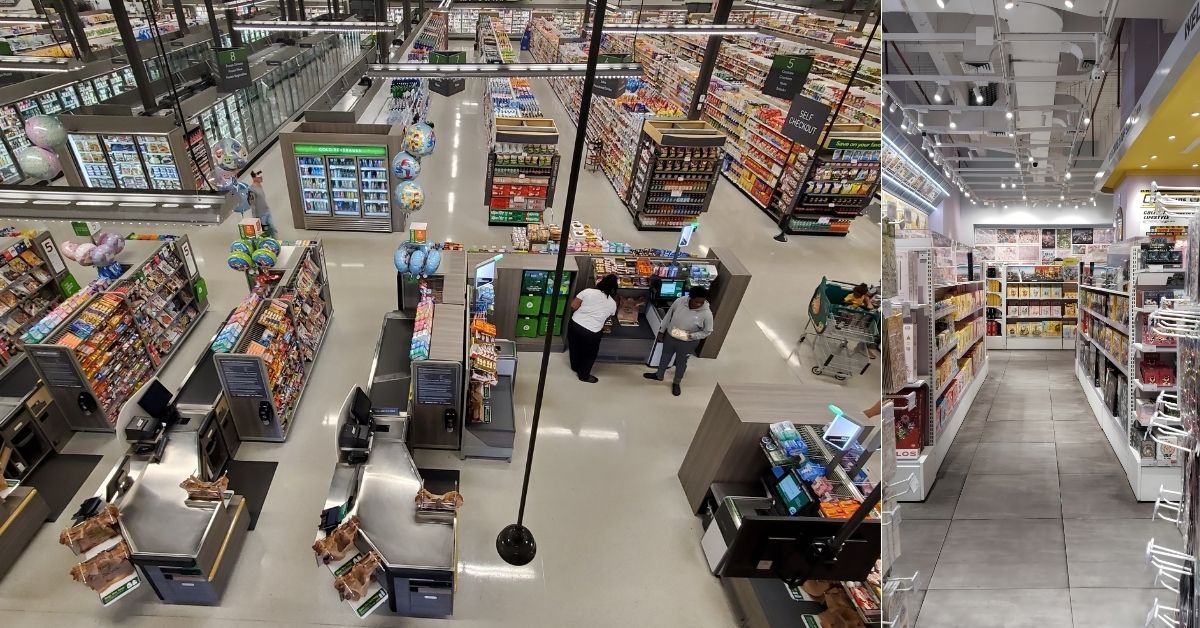
It may be an ideal choice for those who want to enhance convenience, encourage impulse buying, and simplify employees’ work when restocking goods. A grid store layout increases dwell time as most customers find the shelves visually attractive.
They can also pick an item they did not budget for just because they can explore the shop freely. You can make each aisle more visually pleasing with neon signage. The colorful neon light is hard to ignore and can help boost your sales.
2. Spine
Another retail store design that most medium-sized shops can implement is called the spine. As the name suggests, this layout has a huge central corridor. It supports various sections branching from it on each side.
The spine is usually straight, but it can be slightly curved, with other sections surrounding it. Unlike the open retail store layout, a spine design offers connectivity while guiding people along a central path.
Since this path is clear, people can navigate different sections quickly without confusion. Ideal for large shopping malls and product showrooms, you can arrange the best sellers along the spine for easier reach.
You can make it more appealing with catchy displays and neon signage. Above all, the spine store layout is suitale for modern and traditional retail shops because of its simple and flexible structure.
3. Forced Path
Some major stores apply the forced path retail store design. It entails a premade pathway that customers follow to explore the entire store. Once you enter the shop through the entrance, you will walk on the guided path and exit the shop without seeing it again.
The forced path retail layout works out best for retailers looking to capitalize on impulse buying. Along the predetermined path, customers encounter all the goods that the retail shop sells. With a forced path retail design, you can showcase classy furniture or other goods that require maximum exposure and dwell time.
4. Loop
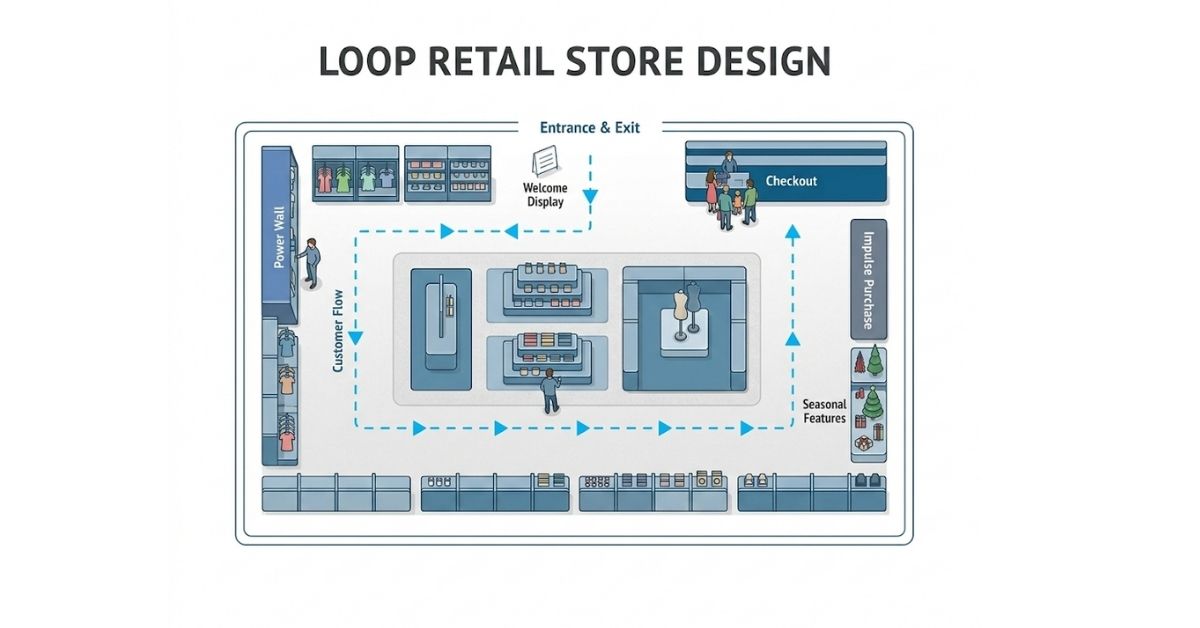
If you have ever been to a racetrack, you can envision a loop retail store design. The layout includes a well-defined circular path through the length of the store. Just like the forced path, customers encounter a wide assortment of goods along the path. However, a loop store layout encourages customers to move in circles.
It lowers the risk of them getting bored and frustrated along the way, while the fixed and rigid forced path layout does not. Without the barriers used in the forced path, the loop design gives the customers a detailed tour of various departments. Most large-scale fashion apparel and accessory stores apply the less restrictive and freer style loop design.
5. Diagonal
What is a diagonal retail store design? A diagonal design has all the aspects of a grid store layout except the direction of the shelves. All product shelves have a diagonal orientation, allowing shoppers to get better visibility of the displayed merchandise.
A grid layout can look disorganized if you place many products on the shelves. On the other hand, even fully loaded shelves are easier to explore.
6. Free-Flow
A retail store design that offers the shopper maximum freedom of exploration is the free-flow layout. It is the opposite of the forced path store design. With a free-flow retail layout, you release your design genius without limitation.
You follow no standard way of designing your shop space, as the goal is to create a perfect atmosphere for dwell time and conversion. You can pick racks, stands, and displays of any shape and size. Additionally, you can freely select the most preferred design elements to improve the ambiance.
If you need small retail store design ideas, the free-flow style tends to fit small-scale and medium-sized shops, such as boutiques. Although it offers freedom to create and allows customers to move in any direction, the free-flow shop layout can encourage cluttering and confusion. It may reduce your store space utilization efficiency.
7. Angular
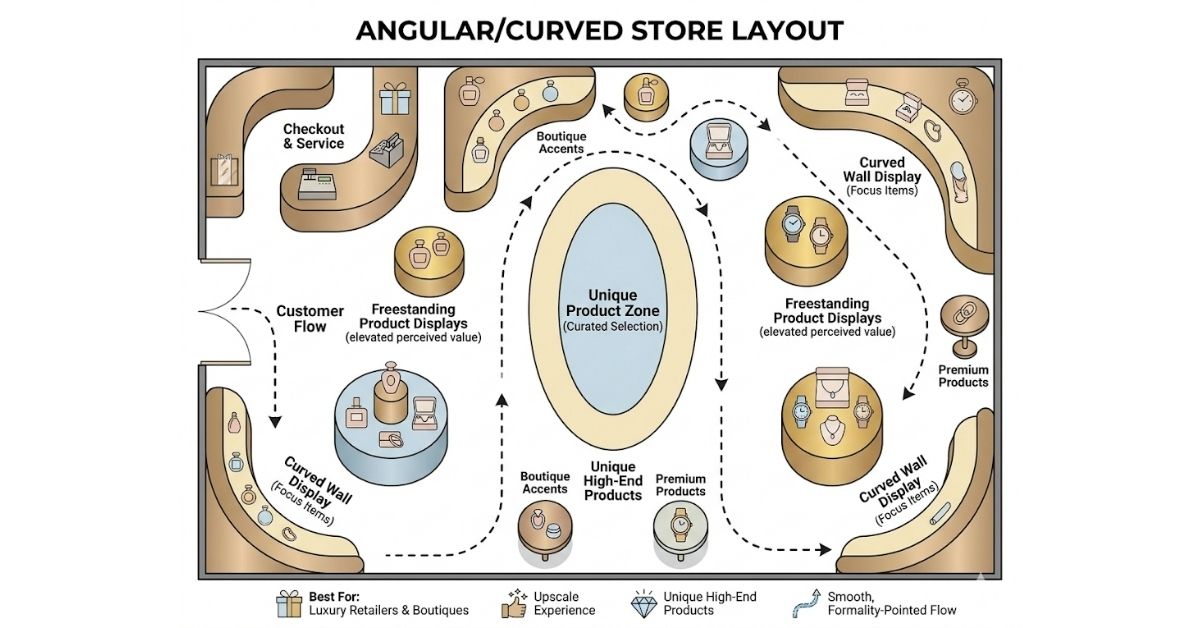
Another retail store design some retailers use is the angular layout. It uses curved or rounded paths and fixtures to let shoppers move without restrictions. Another name for the angular store design is the curved layout.
Everything looks circular or curved, giving the store a sophisticated look. If you dislike straight lines and basic arrangements, the angular style is more innovative. It allows customers to move to any section they want, taking the time to discover your products.
This layout is an ideal one for highlighting and calling attention to specialty goods. You only need many free-standing product displays in the middle of your shop. Based on its description, the angular retail store design is perfect for anyone selling luxury merchandise.
It fits jewelry, special goods that are rare to find, and high-end designer clothing and accessories. The angular retail shop design is for those targeting shoppers who take their time to explore and interact closely with products.
8. Geometric
The geometric retail store layout is a vibrant design with product displays of varying shapes and sizes. It can complement a retail store with a unique interior design. The layout allows you to mix and match fixtures and displays as long as they create a classy and beautiful look.
This flexible shop layout enables you to create a matching ambiance with suitable graphics, music, lights, and scents. You can use a geometric retail store design to direct customers to specialty goods from the brands you support.
It is an ideal layout for reinforcing your brand identity without overspending. The use of geometric-shaped displays allows you to categorize your merchandise for maximum product exposure and conversions.
Which Retail Store Layout Should You Choose?
When it comes to the best retail store design for your business, you are the judge. Only you know what you sell, who your audiences are, and how they behave when they enter your shop. Start by making a few goals you would like to achieve.
Perhaps you want to showcase all your merchandise and encourage impulse buying. If this is the case, the forced path and loop store layouts make sense. Probably you want to attract upscale customers who dwell in the shop for a long time to scan every premium product.
If so, the free-flow and angular store designs are perfect. Maybe you want customers to explore different aisles before they find the intended item, which can encourage impulse buying. The grid and diagonal store designs may be the best choices.
Final Word
A retail store design that fits your shop is not as hard to find as you might think. After understanding the differences between various store designs, you will decide the type that suits your business. You can even get a bit creative and mix different layouts in one shop as long as you do not confuse and annoy the customer.